Carolina Day School


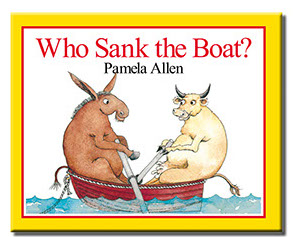
Who Sank the Boat?
Investigating Why a Nail Sinks but a Boat Floats
How you can help extend your child's learning.
The delightful children's book - Who Sank the Boat? - opens this integrated learning unit designed to help students begin to understand how scientific thinking helps us understand the world around us. As part of the unit, students make predictions; create simple tests to gather evidence; and gain experience in using evidence to explain the world around them.
- Ask your child about what they learned in this unit.
- Ask your child to describe what he/she observed when investigating sinking and floating.
- Children at this age are likely to believe that "big/heavy" things sink and "little/light" things float. While this idea may explain some observations, it doesn't work when confronted with the question....Why does a little nail sink, but a great big cruise ship floats?
- Ask your child to explain something important in explaining why some things sink and others float. (What students experienced is that shape is important in determining sinking and floating. They worked with a piece of clay and by changing its shape could get the clay to float or to sink.)
- Encourage your student to offer evidence in support of any explanations for what he/she observed. For example: does your child include examples from the simple experiments to support her/his answer? If not, ask your child for such. (When I made the clay into a ball...it sank. But when I made is look like a canoe...it floated.
- Sinking and floating is a complex topic and the purpose of our lesson is NOT to try to teach why some things sink and others float. Instead, our goal is to: 1) help students confront the simplistic view that big/heavy things sink and little/light things float; and 2) experience that science uses observation, experiments and evidence to explain the world around us.
Read More About Evidence


Back to Unit
(button only
available
to teachers)
Upload class photos